PET Tracer Classification and the Tau Therapeutic Window

 Mayo Clinic AI Summit
I presented two contributions at the Mayo Clinic AI Summit (June 4 - 5, 2026).
In the podium talk, I described a 2.5D ConvNeXt classifier that identifies the radiotracer of a brain PET scan directly from the image. The model reached a Matthews correlation coefficient of 0.93 across tracer classes. This accuracy supports automated quality control and harmonization in large multitracer imaging archives, where tracer labels are often missing or inconsistent.
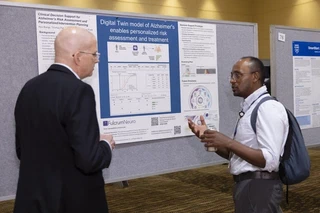
The poster introduced the tau therapeutic window, a biological staging based eligibility criterion for anti-amyloid therapy. The window identifies patients early enough in the disease course for treatment to plausibly change the trajectory.
Mayo Clinic, Rochester, MN
200 First St SW, Rochester, MN 55905
Overview
I presented two pieces of work at the Mayo Clinic AI Summit (June 4-5, 2026): a podium talk on automated PET tracer classification and a poster on the tau therapeutic window.
PET Tracer Classification
The classifier reads a brain PET volume and predicts which radiotracer produced it. It uses a 2.5D ConvNeXt backbone and reached a Matthews correlation coefficient of 0.93 across tracer classes. Reliable tracer labels matter for any pipeline that pools amyloid, tau, and FDG scans, so this model removes a manual step that scales poorly across thousands of images.
Tau Therapeutic Window
The poster defined the tau therapeutic window, a tau PET SUVR range over which anti-amyloid therapy can plausibly alter the disease course.
Photos